
Category: Metabolic & Body Composition
NAD+ Research and Insulin Sensitivity: What Human Trials Actually Measured
Posted on July 29, 2026
Introduction
Can NAD+ research tell a woman in midlife anything useful about insulin sensitivity, energy metabolism, or body-composition change?
That question is more specific than the usual wellness-language version. The stronger human literature is not mostly about “boosting energy” in a vague sense. It is about whether oral NAD+ precursors, mainly nicotinamide riboside and nicotinamide mononucleotide, change measurable biology: blood NAD+ metabolites, skeletal-muscle NAD+ pools, insulin-stimulated glucose disposal, liver fat, blood pressure, and gene-expression patterns.
The short version: human trials show that some NAD+ precursors can raise NAD-related metabolites. Whether that translates into meaningful metabolic outcomes is much less consistent. One small randomized trial in postmenopausal women is genuinely relevant to midlife readers, but it does not settle the question on its own.
For basic terminology, the Nu-Forme Labs glossary is the better place to start. Here, we are staying with the studies: who was enrolled, what was measured, and where the evidence gets over-interpreted.
What the NAD+ research set out to answer
Across the human trials reviewed here, researchers were not asking one single question.
Some studies were built as safety and pharmacokinetic trials: if adults take an oral NAD+ precursor for several weeks, do NAD-related metabolites rise in blood, and are there obvious tolerability problems?
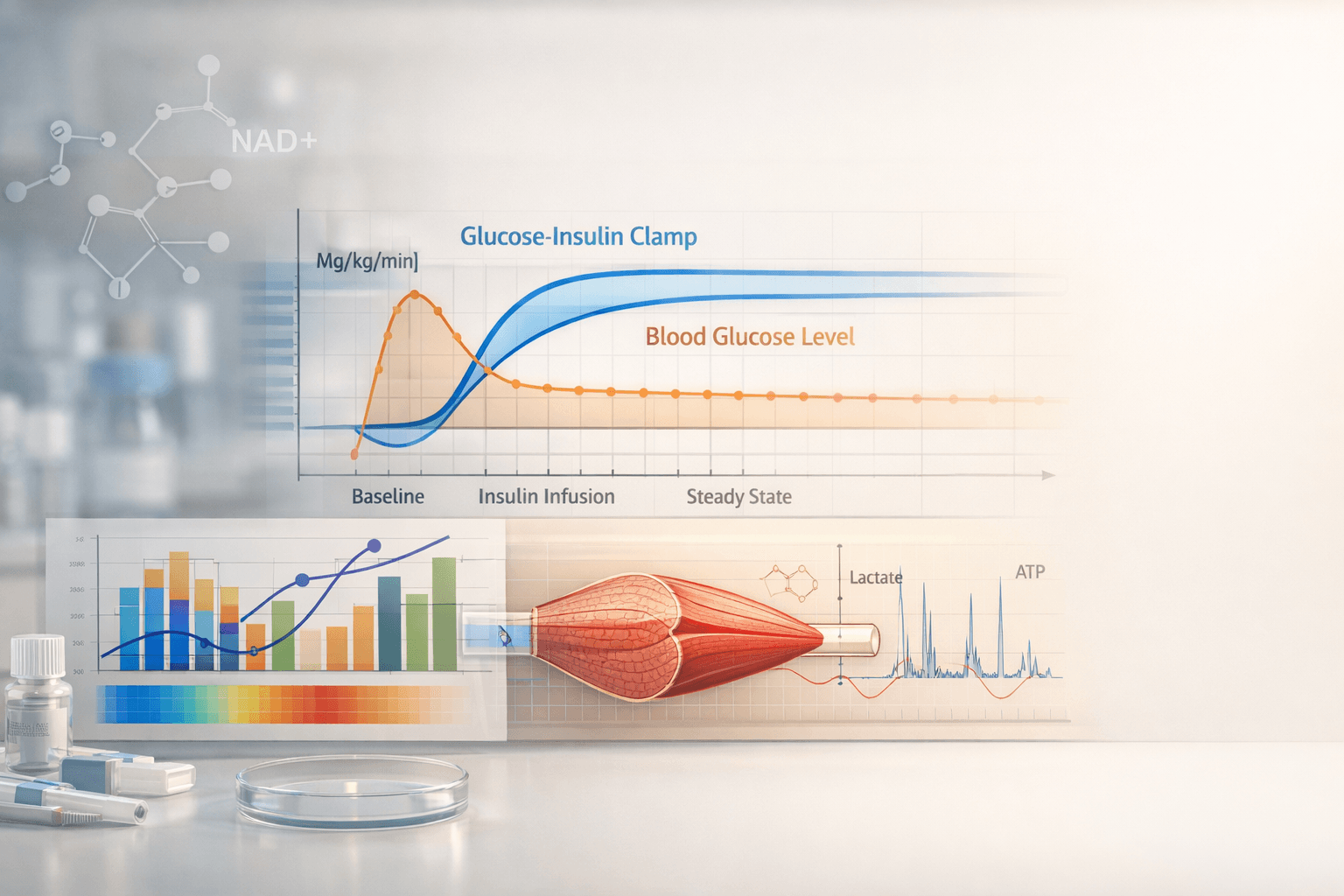
Others were metabolic physiology studies. Those are the more interesting ones for readers thinking about midlife metabolic change. They used tools such as hyperinsulinemic-euglycemic clamps, muscle biopsies, magnetic resonance spectroscopy, and transcriptomic analysis to ask whether higher NAD+ availability shows up as altered insulin sensitivity or skeletal-muscle biology.
That distinction matters. Raising a biomarker is not the same as changing an outcome. A blood NAD+ metabolite result is a mechanistic signal. A clamp-measured improvement in glucose disposal is closer to a metabolic outcome. A change in body weight, waist circumference, or long-term diabetes risk would be a different level of evidence again.
What the human NAD+ precursor studies did
The postmenopausal women’s trial: NMN and insulin sensitivity
The most directly relevant study for midlife women was a randomized, placebo-controlled trial by Yoshino and colleagues, published in Science in 2021.
This was a human RCT enrolling 25 postmenopausal women with prediabetes who were overweight or had obesity. Participants received oral nicotinamide mononucleotide, 250 mg per day, or placebo for 10 weeks.
The key endpoint was not a symptom score or a before-and-after photograph. Researchers used a hyperinsulinemic-euglycemic clamp, a demanding metabolic test that measures how much glucose the body can dispose of under controlled insulin stimulation. They also examined skeletal-muscle insulin signaling and gene-expression patterns.
The obese men’s trial: NR and clamp-measured metabolism
Dollerup and colleagues ran a randomized, placebo-controlled trial in 40 obese, insulin-resistant men. Participants received oral nicotinamide riboside chloride at 2,000 mg per day, or placebo, for 12 weeks.
This study also used insulin-sensitivity measurements and looked at skeletal muscle and lipid metabolism. It is useful because it tested a longer duration and a higher NR dose than some earlier studies. It is less useful for women because it enrolled men only.
The older-adult crossover trial: NR, NAD+ metabolites, and vascular measures
Martens and colleagues studied 24 healthy middle-aged and older adults in a randomized, placebo-controlled crossover trial. Participants received oral nicotinamide riboside chloride at 1,000 mg per day for six weeks, with placebo used as the comparator in the crossover design.
The primary focus was whether chronic NR supplementation was tolerable and whether it raised NAD+ metabolites in blood. The study also looked at exploratory cardiometabolic measures, including blood pressure and arterial stiffness.
This is the sort of trial that often gets cited broadly, but its metabolic endpoint is not the same as an insulin-sensitivity trial in insulin-resistant participants.
The overweight-adult safety trial: dose-ranging NR
Conze and colleagues conducted a randomized, double-blind, placebo-controlled trial in 140 healthy overweight adults. Participants received placebo or oral NR chloride at 100 mg, 300 mg, or 1,000 mg per day for eight weeks.
The main purpose was safety and metabolism. The study measured NAD+ metabolite changes and monitored laboratory values and adverse events. It was not designed to prove body-composition change or improved insulin action.
The older-men muscle-biology study: NR and skeletal muscle signaling
Elhassan and colleagues studied 12 older men given oral nicotinamide riboside at 1,000 mg per day for 21 days. This was a human open-label study without a placebo group.
The researchers used muscle biopsies to examine NAD+ metabolites and molecular signatures in skeletal muscle. That makes it mechanistically interesting, but it does not provide placebo-controlled evidence of improved physical performance, body composition, or insulin sensitivity.
What the NAD+ studies found
In the women-only human RCT, Yoshino and colleagues reported that 10 weeks of oral NMN increased skeletal-muscle insulin sensitivity compared with placebo in postmenopausal women with prediabetes. The study also observed changes in muscle insulin signaling and expression of genes linked with muscle remodeling.
That is the strongest women-specific metabolic finding in this group of studies. But it was small: 25 participants total. It also did not show broad changes across every cardiometabolic marker someone might care about. Body weight, liver fat, and several systemic markers did not meaningfully shift over the 10-week period.
In the male-only human RCT, Dollerup and colleagues found that 12 weeks of high-dose oral NR raised NAD-related metabolites but did not improve insulin sensitivity in obese, insulin-resistant men. That is a useful reminder: more NAD+ metabolite signal does not automatically mean better clamp-measured metabolic function.
In the crossover trial by Martens and colleagues, oral NR increased blood NAD+ metabolites in healthy middle-aged and older adults. The study also reported exploratory signals related to blood pressure and arterial stiffness, but those findings need to be read as hypothesis-generating rather than decisive.
In the larger dose-ranging trial by Conze and colleagues, NR produced dose-related increases in NAD+ metabolites over eight weeks and was studied primarily as a safety and metabolism intervention in overweight adults. It did not establish that NAD+ precursor use changes insulin sensitivity, fat mass, or long-term metabolic outcomes.
In the open-label older-men study by Elhassan and colleagues, NR increased skeletal-muscle NAD+ metabolite measures and produced molecular changes in muscle tissue. Because there was no placebo group, the trial cannot tell us how much of the observed change was due to NR rather than time, diet, study participation, or other uncontrolled factors.
Taken together, the human NAD+ research supports one narrow statement: several oral NAD+ precursors have been shown in human studies to alter NAD-related metabolite biology. The outcome story is uneven. One small postmenopausal women’s RCT reported improved muscle insulin sensitivity; another male RCT did not.
What this tells us about women specifically
This is where the literature gets both more interesting and more frustrating.
The Yoshino trial enrolled 100% women, and not just women as an afterthought. It specifically studied postmenopausal women with prediabetes, a population that maps more closely onto the concerns many midlife readers actually have: changing insulin sensitivity, altered fat distribution, and the sense that old metabolic assumptions no longer apply.
Menopausal status was reported in that study. That is unusual and valuable. The trial did not need sex-stratified analysis because all participants were women, but its small size means it should be treated as an early signal, not a settled answer.
The other studies are less satisfying from a women’s-data standpoint. Dollerup enrolled men only. Elhassan enrolled men only. Martens enrolled both sexes, but the outcomes were not reported in a way that lets a reader understand whether women responded differently. Conze included overweight adults, but sex-specific metabolic conclusions were not the point of the trial.
No study reviewed here meaningfully addressed perimenopause. None addressed postpartum recovery. None studied breastfeeding, and nothing in this literature should be stretched into that context.
For a woman reading NAD+ research during perimenopause or menopause, the honest answer is this: there is one directly relevant postmenopausal RCT, and it is worth reading carefully. But the broader NAD+ precursor literature still leans heavily on mixed-sex or male-only designs, short durations, and endpoints that do not always translate into lived metabolic outcomes.
What this doesn't tell us
The largest limitation is that NAD+ precursor research is often discussed as though all formulations, routes, and compounds are interchangeable. They are not.
Most human trials here studied oral nicotinamide riboside or oral nicotinamide mononucleotide. That evidence should not be casually transferred to injectable NAD+, topical products, blends, or unrelated “cellular energy” claims.
The second limitation is duration. Ten weeks, twelve weeks, and even eight weeks can identify biological signals, but they do not answer long-term questions about sustained insulin sensitivity, body composition, frailty, diabetes progression, or cardiovascular outcomes.
The third limitation is endpoint mismatch. NAD+ metabolite increases are not the same as improved insulin sensitivity. Improved insulin-stimulated glucose disposal is not the same as weight loss. Gene-expression changes in muscle are not the same as better strength, recovery, or day-to-day energy.
Funding and conflicts also deserve attention. Several NAD+ precursor studies involved industry support, supplied study material, patents, or declared commercial relationships. That does not make the findings unusable. It does mean readers should look closely at study design, comparator choice, endpoints, and whether results were replicated by independent groups.
Finally, regulatory status should not be blurred. NAD+ precursors studied in trials are not FDA- or Health Canada-approved drugs for insulin sensitivity, weight management, menopause symptoms, or metabolic disease. Research-use supply is a separate category from drug approval, and compounding-list discussions are separate again.
Sources
-
Yoshino M, Yoshino J, Kayser BD, et al. Nicotinamide mononucleotide increases muscle insulin sensitivity in prediabetic women. Science. 2021. Study type: human RCT; n=25; 100% female; oral NMN 250 mg/day for 10 weeks; comparator: placebo.
-
Dollerup OL, Christensen B, Svart M, et al. A randomized placebo-controlled clinical trial of nicotinamide riboside in obese men: safety, insulin sensitivity, and lipid-mobilizing effects. American Journal of Clinical Nutrition. 2018. Study type: human RCT; n=40; 0% female; oral NR chloride 2,000 mg/day for 12 weeks; comparator: placebo.
-
Martens CR, Denman BA, Mazzo MR, et al. Chronic nicotinamide riboside supplementation is well-tolerated and elevates NAD+ in healthy middle-aged and older adults. Nature Communications. 2018. Study type: human randomized crossover trial; n=24; mixed-sex; oral NR chloride 1,000 mg/day for six weeks; comparator: placebo.
-
Conze DB, Crespo-Barreto J, Kruger CL. Safety and metabolism of long-term administration of NIAGEN in a randomized, double-blind, placebo-controlled clinical trial of healthy overweight adults. Scientific Reports. 2019. Study type: human RCT; n=140; oral NR chloride 100, 300, or 1,000 mg/day for eight weeks; comparator: placebo.
-
Elhassan YS, Kluckova K, Fletcher RS, et al. Nicotinamide riboside augments the aged human skeletal muscle NAD+ metabolome and induces transcriptomic and anti-inflammatory signatures. Cell Reports. 2019. Study type: human open-label study; n=12; 0% female; oral NR 1,000 mg/day for 21 days; comparator: none.
Working With Nu-Forme Labs
Nu-Forme Labs approaches research compounds from the boring-but-important side: identity, purity, testing, documentation, and transparent Canadian supply.
For readers comparing research materials, the NAD+ product page, the Nu-Forme Labs glossary, and the peptide certificate of analysis guide are better starting points than broad claims about “cellular energy.” The study details matter. So does the paperwork.
Final Thoughts
The best human NAD+ research is more nuanced than the marketing around it.
Yes, oral NAD+ precursors have changed NAD-related metabolite measures in human trials. Yes, one small placebo-controlled trial in postmenopausal women reported improved skeletal-muscle insulin sensitivity. But the broader clinical picture is mixed, especially when studies move from biomarkers to metabolic outcomes.
For midlife women, the useful takeaway is not certainty. It is better literacy: look for the population, the endpoint, the comparator, and whether menopausal status was actually recorded. In this literature, that single detail often separates a relevant trial from a study that only looks relevant at first glance.
Frequently asked questions
- Is the NAD+ research mostly about injectable NAD+?
- No. The strongest human trials discussed here mostly studied oral NAD+ precursors such as nicotinamide riboside and nicotinamide mononucleotide. Those results should not be automatically transferred to injectable NAD+ or unrelated formulations.
- Did the studies show weight loss?
- Not in a way that supports a clear weight-loss claim. Several trials focused on NAD+ metabolites, insulin sensitivity, muscle biology, or safety rather than body weight as a primary outcome.
- How good is the evidence for postmenopausal women?
- There is one small but relevant placebo-controlled trial in postmenopausal women with prediabetes. It is useful because it measured insulin sensitivity carefully, but it is too small and short to settle long-term metabolic questions.
- Why do NAD+ metabolite results not prove metabolic benefits?
- A metabolite change shows that the compound affected a biochemical pathway. It does not automatically show improved insulin sensitivity, body composition, symptoms, or long-term health outcomes.